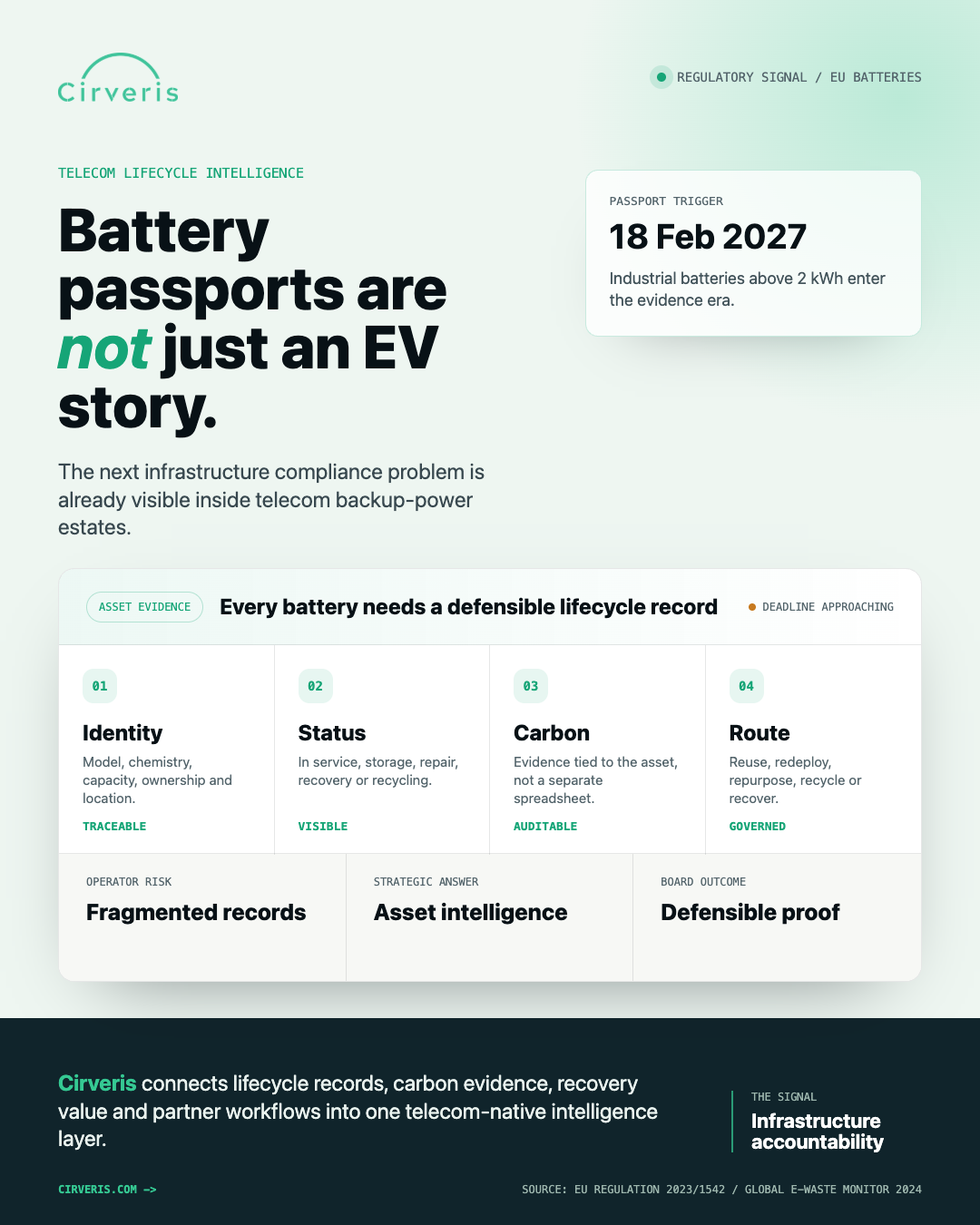
Battery passports are often discussed as an electric-vehicle issue. That is too narrow.
The EU Batteries Regulation is now in force. From 18 February 2027, each LMT battery, each electric vehicle battery and each industrial battery with a capacity greater than 2 kWh placed on the EU market or put into service must have an electronic battery passport. The same regulation explicitly treats batteries intended for communication infrastructure as industrial batteries.
For telecom operators, tower companies, energy-infrastructure owners, data-centre operators, utilities and industrial asset owners, this matters because modern infrastructure is full of battery-backed systems: towers, shelters, edge facilities, backup power, UPS rooms, hybrid-energy sites, storage locations and replacement stock.
Those batteries are no longer just maintenance items. They are becoming traceable infrastructure records.
What is changing
The battery market is entering a stricter phase of lifecycle accountability. The European Commission has said global battery demand is expected to increase 14 times by 2030. At the same time, regulation is moving from broad environmental intent toward asset-level data requirements.
The battery passport is designed to improve transparency across supply and value chains. It supports tracking and tracing, carbon-intensity information, materials origin, composition, repair, repurposing, dismantling, treatment, recycling and recovery information.
That language matters. It moves the conversation from disposal compliance toward lifecycle evidence.
Why this matters for infrastructure
Infrastructure owners have historically been able to manage many physical assets through procurement files, site records, partner spreadsheets, warehouse lists and end-of-life certificates. That model becomes weaker as regulation, carbon reporting and circularity scrutiny move toward proof at asset level.
- Which batteries are in service, in storage, in transit, failed, repurposed, recovered or recycled?
- Which batteries sit above thresholds that trigger passport expectations in relevant markets?
- Which assets have complete provenance, condition, chemistry, service history and end-of-life evidence?
- Which batteries can be redeployed, refurbished, repurposed, sold, recycled or reported?
- Which carbon and recovery claims can survive audit?
The issue is not that operators lack effort. The issue is that lifecycle data often sits across operations, procurement, site maintenance, sustainability teams, warehouses, vendors, logistics partners and recyclers. When regulation requires structured evidence, fragmented records become a commercial and governance risk.
The wider e-waste context
Battery passports also sit inside a larger global shift. The Global E-waste Monitor 2024 reports that the world generated a record 62 million tonnes of e-waste in 2022 and is on track to reach 82 million tonnes by 2030. It also reports that only 22.3% of 2022 e-waste was documented as properly collected and recycled.
That is highly relevant to telecom and infrastructure sectors. Networks, data centres, energy systems and industrial sites contain batteries, radios, baseband units, power systems, cabinets, cables, devices, spares and decommissioned equipment. As modernisation cycles, shutdowns, replacements and sustainability obligations converge, organisations will need more than ESG narratives.
They will need asset-level evidence.
The board-level question
For leadership teams, the battery-passport signal creates a board-level question: can we prove what happened to our critical infrastructure assets across their lifecycle?
That question cuts across several executive domains. For operations teams, it is about visibility, resilience, replacement planning and asset condition. For finance and procurement teams, it is about residual value, avoided procurement, inventory control and recovered capital. For sustainability teams, it is about carbon evidence, circularity claims and audit readiness. For risk and compliance teams, it is about traceability, custody, documentation and partner governance.
Battery passports are one regulatory expression of a broader reality: infrastructure assets are becoming data-bearing obligations.
Where operators should start
- Establish a group-wide battery asset register that captures asset class, location, chemistry where available, supplier, installation status, ownership, condition, capacity, service history and lifecycle state.
- Map evidence gaps, especially missing serial numbers, unclear custody, weak condition grading, incomplete recycling certificates and unstructured partner records.
- Connect carbon and financial records so the same asset can support reporting, circularity evidence, residual-value decisions and recovery pathways.
- Build partner governance into the workflow so vendors, recyclers, refurbishers, logistics providers and site teams can contribute evidence without creating another spreadsheet layer.
- Treat passports as part of infrastructure intelligence, not as an isolated compliance project.
Where Cirveris fits
Cirveris is designed for this type of problem. It is not a generic sustainability dashboard. It is a lifecycle intelligence platform built around the relationship between assets, carbon, financial value, documentation and partner workflows.
The market is moving toward asset-level proof. Regulations such as the EU Batteries Regulation show the direction of travel: traceable records, lifecycle evidence, carbon-related data, repair and recovery pathways, and controlled access to trusted information.
For infrastructure operators, that means circularity cannot sit outside the operating model. It has to be connected to the asset record.
Battery passports are the signal. Infrastructure lifecycle intelligence is the response.
The sectors affected by the shift
Telecom is one of the clearest examples because backup power is distributed across thousands of sites. The same pattern applies to energy storage, data centres, utilities, industrial facilities, transport infrastructure and large enterprise estates. In each case, batteries and related hardware are moving from operational background assets into governed lifecycle records.
The commercial implication is simple: a battery estate that is poorly documented becomes harder to value, harder to replace intelligently, harder to reuse and harder to defend in a reporting environment.
What data teams should collect now
- Battery identity: manufacturer, model, chemistry, capacity, serial number and installation date.
- Operational state: cycle count, state of health, measured capacity, failures and maintenance history.
- Lifecycle status: in service, stored, moved, failed, repaired, redeployed, recovered or recycled.
- Sustainability data: carbon footprint, recycled content, critical raw-material declarations and due-diligence information where available.
- Disposition evidence: reuse eligibility, second-life route, recycler, certificates, transport documents and partner records.
Commercial benefit beyond compliance
Better battery data improves operational decisions immediately. It supports replacement planning, reduces over-procurement, improves resilience forecasting and helps identify assets suitable for second-life use. For resale, redeployment or recovery, state-of-health and provenance data can be the difference between a trusted asset and a liability.
The leadership lesson
The key leadership point is that a battery passport is not a document created at end of life. It is a living record that begins at procurement and is maintained through installation, service, testing, movement and disposal. Teams that understand this early can build normal operational processes around evidence instead of treating compliance as a late-stage emergency.
Procurement must change before operations can comply
Battery-passport readiness starts in supplier contracts. Infrastructure owners should request machine-readable product data, carbon-footprint declarations where available, chemistry and capacity data, recycled-content information, state-of-health interfaces, safety documentation and end-of-life instructions at purchase. If those fields are not captured at procurement, operations will struggle to reconstruct them years later.
This is particularly important for distributed estates. Batteries may sit across thousands of telecom sites, energy assets, data-centre rooms, industrial facilities and storage locations, often serviced by different contractors. Without consistent product and maintenance data, a battery estate becomes hard to value, hard to replace intelligently and hard to prepare for second life.
- Add passport-ready data requirements to battery tenders.
- Require serial-level records for batteries above relevant thresholds.
- Store chemistry, capacity, installation date and site history centrally.
- Record state-of-health tests as operational events, not loose documents.
- Keep end-of-life routes and certificates tied to the battery identity.
Operational readiness checklist
The education point for site, energy, facilities and operations teams is practical: a battery is not only a consumable. It is an asset with lifecycle data. Teams should know which batteries are passport-relevant, which are critical for resilience, which are eligible for reuse, and which require controlled disposal. That knowledge improves compliance and operational reliability.
This article is provided for general information and does not constitute legal, regulatory, or financial advice. Regulatory timelines and requirements should be verified against the primary sources cited.